Horse Barn Solar Calculator
Answer 5 questions — get a complete solar system recommendation with panel count, battery sizing, cost breakdown, and payback period.
Size
Peak sun hours determine how much power your panels generate each day — and vary significantly by region.
🐴 Your Barn Solar System Recommendation
Why Horse Barns Need Different Solar Sizing
The Core Misconception
A lot of barn owners walk into solar planning thinking their six-stall facility is just a bigger version of their house. That's the mistake that blows budgets and leaves systems undersized before the first winter hits.
Horse barn solar is categorically different from home solar — not in the panels on the roof, but in how the load actually behaves. Houses run on predictable baseloads: refrigerators, lights, HVAC cycling on and off. Barns spike hard, drop fast, and then spike again.
The Hidden Power Hogs
Here's where the math gets real. Walk through a working barn in January versus July and you're looking at two completely different electrical animals.
Winter draw (per 6-stall barn):
- Heated water buckets: 150–200W each, running continuously to prevent freezing
- Infrared wash rack heaters: 1,500W+ the instant you flip that switch
- Heat lamps over foaling stalls: 250W per lamp, often running overnight
Summer draw (same barn):
- High-velocity stall fans: 100W each, 24 hours a day, 7 days a week
- Heavy-duty exhaust fans pulling air through the aisle: 300–750W depending on motor size
- Well pumps cycling more frequently in heat
That six-stall barn crosses 1kW+ in continuous baseline load before you factor in equipment stacking. Most homeowners never see those numbers.
Equine Facility Solar Sizing Strategy
Standard home solar calculations use average daily consumption and size from there. That method fails equine facility solar sizing because it completely ignores inrush current — the power surge that happens when an industrial motor kicks on.
A dust-resistant exhaust fan motor doesn't just draw 400W when it starts. It can pull three to six times that wattage for the first two seconds. Stack two fans, a water heater, and a wash rack infrared unit starting within the same minute, and your inverter is staring down a load it was never engineered to survive.
The inverter is where most agricultural solar builds go wrong. You need surge-rated inverter capacity — not just continuous wattage ratings — specifically designed to handle simultaneous motor startups in a dusty, high-humidity environment.
Before You Buy a Single Panel
Get a dedicated peak-load assessment done first — not an average consumption estimate, a peak load audit that maps every motor, heater, and resistive load against the worst-case scenario of a cold snap or a July heat wave. That number tells you what your inverter must handle, and everything else — battery capacity, panel count, charge controller sizing — flows from there.
↑ Ready to calculate? Scroll up.
Summer vs. Winter: Horse Barn Solar Seasonality
The Seasonality Paradox
Here's the part that catches most barn owners completely off guard: summer is not your solar system's hardest season. Winter is — and it's not particularly close.
The horse barn solar summer vs. winter reality breaks down to one brutal irony. Your heaviest summer loads run when the sun runs longest and strongest. Your heaviest winter loads kick in exactly when the sun disappears earliest and clouds park themselves over your property for days at a stretch.
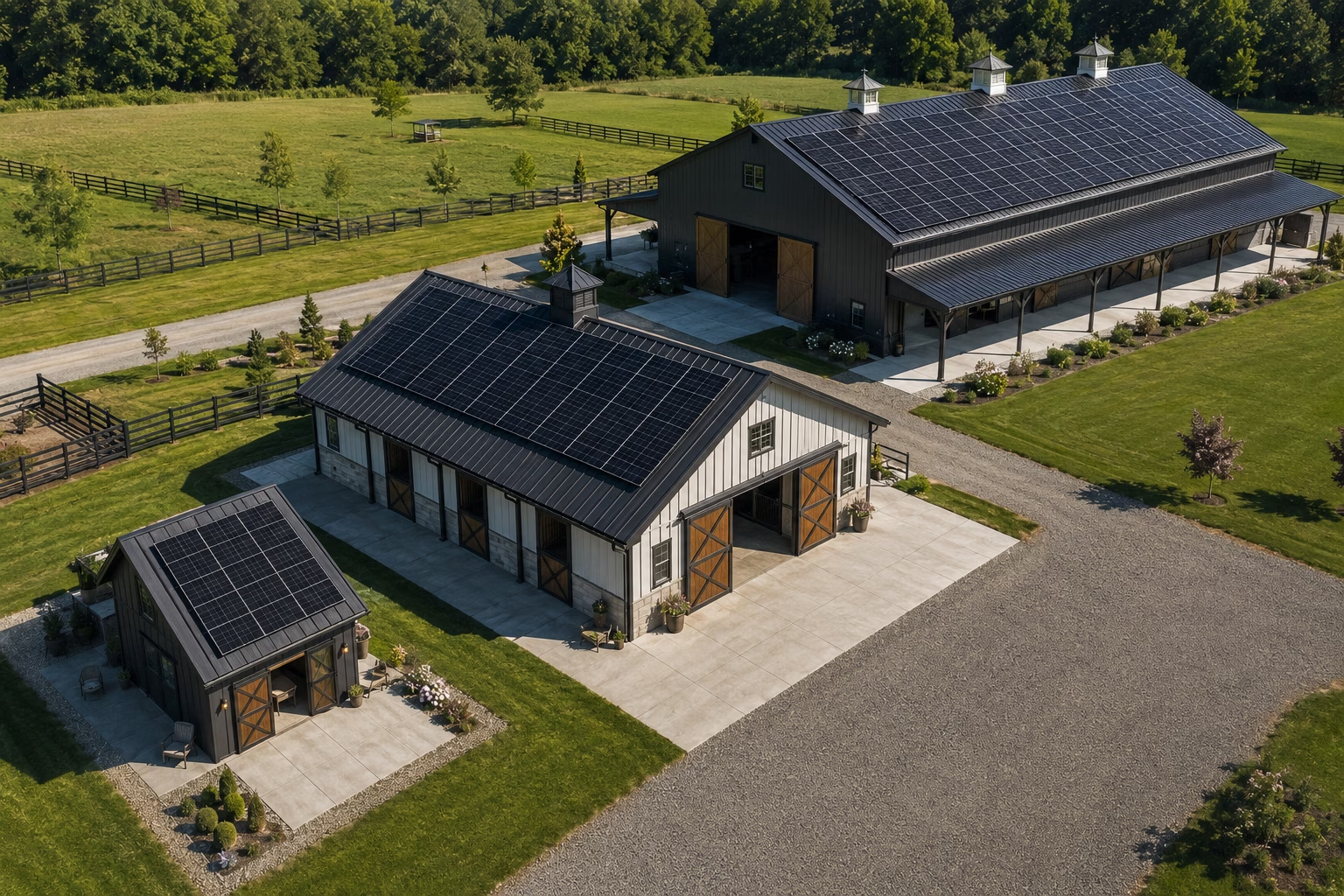
Summer Comfort vs. Winter Survival
Summer barn power is about comfort. High-velocity stall fans pulling 100W per horse run hard, exhaust systems churn through aisle air, and well pumps cycle more frequently — but your panels are producing at their seasonal peak right alongside that demand. The system breathes.
Winter is a different conversation entirely. Heated water buckets running 150–200W per horse, 24 hours a day, aren't optional equipment. Horses that stop drinking due to frozen water develop colic fast, and colic kills. Solar for horse barn winter applications means your system is doing life-safety work, not comfort work.
The Math: How Many Solar Panels to Run Heated Horse Water Buckets?
Let's put real numbers on this. A single 150W heated water bucket draws 3,600 Watt-hours — 3.6 kWh — every single day running continuously.
Multiply that across four horses and you're burning 14.4 kWh daily on buckets alone, before a single fan, light, or pump enters the picture. Now factor in your winter production window: in most of the northern U.S., you realistically work with 2.5 to 3 peak sun hours per day in December and January.
To offset four heated buckets under those conditions, your dedicated array needs to sit between 5,000W and 6,000W — roughly 12 to 15 modern 400W panels — just to cover that one load category.
| Season | Primary Loads | Sun Hours | System Stress |
|---|---|---|---|
| Summer | Fans, pumps, lights | 5–6 hrs/day | Low — panels match demand |
| Winter | Heated buckets, heaters, lights | 2.5–3.5 hrs/day | High — mismatch is severe |
| Year Round | All loads | Varies | Design to winter worst-case |
What Actually Works in the Real World
A 100% solar solution for winter heating loads is technically achievable — but during a week-long overcast freeze event, even a well-sized system will strain. Experienced barn owners build in a generator backup for exactly those stretches, treating it as insurance rather than a primary source.
Thermally insulated bucket covers cut resistive heating demand significantly and deserve serious consideration before you spec additional panels. Every watt you don't consume is a watt you don't need to generate, store, or budget for.
↑ Ready to calculate? Scroll up.
Solar by Barn Size: 2-Stall to 12-Stall Guide
Scaling Your Barn Power
The single biggest mistake barn owners make when shopping solar is pulling numbers from a generic residential calculator. Barn solar sizing starts with one question: how many active stalls are you running, and what does each one actually demand?
The Sizing Matrix
| Barn Size | Daily Usage | Solar Needed | Cost Estimate |
|---|---|---|---|
| 2 stalls | 500 Wh | 400W | $2,000–$3,500 |
| 4 stalls | 1,000 Wh | 800W | $3,500–$5,500 |
| 6 stalls | 1,500 Wh | 1,200W | $5,000–$8,000 |
| 10+ stalls | 2,500 Wh+ | 2,000W+ | $8,000–$15,000 |
These estimates cover basic lighting, stall fans, and light power tool usage. Continuous heavy heating loads — heated buckets, wash rack heaters, foaling lamps — will push every number higher.
Small and Compact Setups
Solar panels for a 2-stall horse barn represent the cleanest entry point into agricultural solar. At 400W of generation and roughly 500Wh of daily consumption, these systems run beautifully on compact 12V or 24V lithium kit setups that a competent installer can commission in a single day.
Scaling to solar power for a 4-stall barn doubles your consumption target to around 1,000Wh daily and pushes your array to 800W — a pair of 400W panels, a mid-range MPPT charge controller, and a properly sized lithium pack handles this without drama.
Mid-Sized Facilities
At six stalls, the system character changes. A 6-stall barn solar system running 1,200W of solar crosses into territory where you need a proper 24V or 48V battery architecture, not a plug-and-play kit. What 1,200W buys you at this scale is genuine reliability — sustained lighting, continuous ventilation, and enough reserve capacity to ride through a cloudy day without cutting loads.
Large Commercial Facilities
Large equine facility solar costs at 10 to 12+ stalls operate on an entirely different tier. These are enterprise agricultural power systems. At 2,000W+ of solar and $8,000 to $15,000+ in installed cost, you're spec'ing heavy-duty 48V split-phase inverters capable of absorbing brutal inrush current from automatic waterers, hydraulic gate systems, and clinical grooming equipment firing simultaneously.
At this scale, bring in a licensed agricultural electrical contractor before you buy a single panel. The design work alone protects the investment.
↑ Ready to calculate? Scroll up.
Off-Grid vs. Grid-Tied for Remote Horse Barns
The Utility Extension Trap
The call comes back from the utility company and the number stops you cold. $15 per foot to trench. Your barn sits 800 feet from the nearest service connection. That's $12,000 before a single wire gets pulled, before a panel gets hung, before a single light switch gets installed.
This is exactly where the remote barn solar vs. running power line debate stops being philosophical and becomes a pure financial calculation.
| Factor | Grid Extension | Off-Grid Solar |
|---|---|---|
| Upfront cost | $10–$30/ft trenching | $3,000–$8,000 installed |
| Permit timeline | Weeks to months | No utility permits |
| Monthly bills | Ongoing utility bills | $0 after installation |
| Outage resilience | ❌ Goes dark with grid | ✅ Fully independent |
| Ownership | Utility owns infrastructure | You own everything |
The Off-Grid Liberation Strategy
A properly spec'd off-grid horse barn solar kit — panels, lithium storage bank, MPPT charge controller, and a quality inverter — goes on the roof in a weekend. Two experienced installers can commission a 1kW to 2kW system from unboxing to live power in two days without digging a single hole in your pasture.
The No-Power-Line Verdict
The math here isn't complicated. If your grid extension quote clears $5,000, start pricing a solid 1kW–2kW off-grid solar and battery package immediately. For a solar for horse barn no power line setup, the economics almost always break in solar's favor the moment distance and terrain enter the picture. You get power faster, spend less upfront, and own every component of the system outright.
↑ Ready to calculate? Scroll up.
Agricultural Solar Tax Credits & Grants for Horse Barns
The 2026 Solar Gold Rush
The federal government is actively writing checks for horse barn solar installations right now, and the vast majority of farm owners never claim a single dollar. The solar tax credit horse barn agricultural incentive stack available in 2026 represents one of the most significant wealth-building opportunities rural landowners have seen in decades.
The 30% Federal Shield
Two separate federal credits apply depending on how your property operates, and picking the wrong one costs you.
- Section 25D — Residential Clean Energy Credit: covers a flat 30% of installation costs but applies only when the barn sits on your primary residential property and the system isn't used for income-generating agricultural activity.
- Section 48 — Investment Tax Credit (ITC): where commercial horse operations belong. If your facility runs boarding, breeding, training, or lessons and generates taxable income, the Section 48 ITC delivers that same 30% federal credit against your business tax liability.
Commercial equine facilities filing under Section 48 can layer MACRS Depreciation directly on top of the credit. A $15,000 solar installation could net you $4,500 in immediate tax credits plus accelerated depreciation write-downs across a five-year schedule.
The Ultimate Jackpot: USDA REAP Grants
The USDA solar grant horse farm program operates under REAP — the Rural Energy for America Program. REAP grants cover up to 50% of total project costs for qualifying rural small businesses and agricultural producers. That means a $12,000 barn solar system potentially drops to a $6,000 out-of-pocket cost before you even apply the 30% ITC on top of what remains.
To qualify, your facility needs to sit in a designated rural area and either generate at least 50% of gross income from agricultural operations or operate as a rural small business. Most working horse farms clear both thresholds without issue.
Your Actionable Next Step
Keep every contractor receipt, equipment invoice, and permitting document completely separate from standard home improvement records the moment your solar project begins. Before you file anything touching Schedule F or a Section 48 ITC claim, sit down with a CPA who works agricultural accounts regularly. The incentive stack is real and substantial — but only a qualified tax professional ensures you capture all of it cleanly.
↑ Ready to calculate? Scroll up.
Horse Barn Solar — FAQ
A 4-stall barn with basic lighting, fans, and a water pump needs roughly 800W of solar — two 400W panels. Add heated water buckets in winter and that number jumps to 2,000W–3,000W. Use the calculator above with your specific appliance list for a precise recommendation.
Yes, but it requires serious system sizing. One 150W heated bucket draws 3.6 kWh daily. Four buckets = 14.4 kWh/day on buckets alone. Combined with short winter sun hours (2.5–3 hrs/day in the northern US), you'll need 5,000W–6,000W of panels plus a 20–30 kWh lithium battery bank. A generator backup is strongly recommended for extended cloudy stretches.
If your barn is more than 300–400 feet from the nearest service connection, solar almost always wins on cost. Utility trenching runs $10–$30+ per foot, plus permits and inspection timelines that can take months. A complete off-grid solar system for a small-to-medium barn costs $3,000–$8,000 installed, goes live in days, and carries zero monthly bills afterward.
A 6-stall barn running six stall fans, LED barn lighting, aisle lights, and a water pump typically needs 1,200W–1,600W of solar capacity. Budget for a 24V or 48V battery architecture — at least 15–20 kWh of lithium storage — to handle overnight loads and cloudy day gaps. Add AC loads or winter heating and that sizing rises significantly.
Yes — commercial horse operations qualify for the 30% Section 48 Investment Tax Credit (ITC), plus MACRS accelerated depreciation. The USDA REAP grant program also covers up to 50% of project costs for qualifying rural agricultural producers. Most boarding, training, and breeding facilities clear the eligibility thresholds. Consult an agricultural CPA before filing any solar-related tax claims.
Yes, but a wash rack hot water heater is one of the highest single loads in a barn — 1,500W–3,000W for the heating element alone. For solar to handle this, you need a properly surge-rated pure sine wave inverter (minimum 3,000W continuous / 6,000W surge), a large battery bank, and an array sized to fully recharge between uses. Many barn owners run a dedicated on-demand propane heater for this load instead, reserving solar for everything else.
Kentucky averages 4.5 peak sun hours annually, dropping to roughly 3.0–3.5 hours in December and January. Virginia is similar at 4.3 annual average. Solar absolutely works in both states year-round — but winter sizing must account for those reduced production windows. Size your array to your worst winter month, not your annual average, and add 25–35% additional battery capacity over what a purely summer-based calculation suggests.
Complete off-grid horse barn solar system costs range from $2,000–$3,500 for a basic 2-stall setup to $8,000–$15,000+ for a full 10–12 stall commercial facility. Those figures cover panels, lithium battery bank, MPPT charge controller, pure sine wave inverter, and mounting hardware. After the 30% federal ITC and any applicable USDA REAP grant, your effective out-of-pocket cost can drop 50–65% from the gross installed price.